
Yayoi Kusama, the Japanese avant-garde artist whose colourful polka dots, pumpkins and Infinity Mirror Rooms made her one of the world’s most recognisable artists, has died at 97.
Kusama died at a hospital in Tokyo on 14 August. A statement from her company reported by the BBC on 27 August read: “Throughout an extraordinary lifetime devoted entirely to artistic creation, Kusama pursued an internationally acclaimed career as a pioneering avant-garde artist whose creative practice encompassed visual art, performance, fiction, and poetry.”
“She continued to paint until her final days, never setting aside her brush, and continued exploration of forever love and eternal soul. We will carry forward Kusama’s wishes and, through art, continue to bring hope and strength for the future to people around the world,” the statement continued.
Kusama spent much of her later life living voluntarily in a psychiatric hospital, where she continued to create art. Her work eventually became a global phenomenon, attracting millions of visitors and making her one of the world’s highest-earning female artists. A 2022 auction saw one of her paintings sell for around $10.5million (£7.7million).
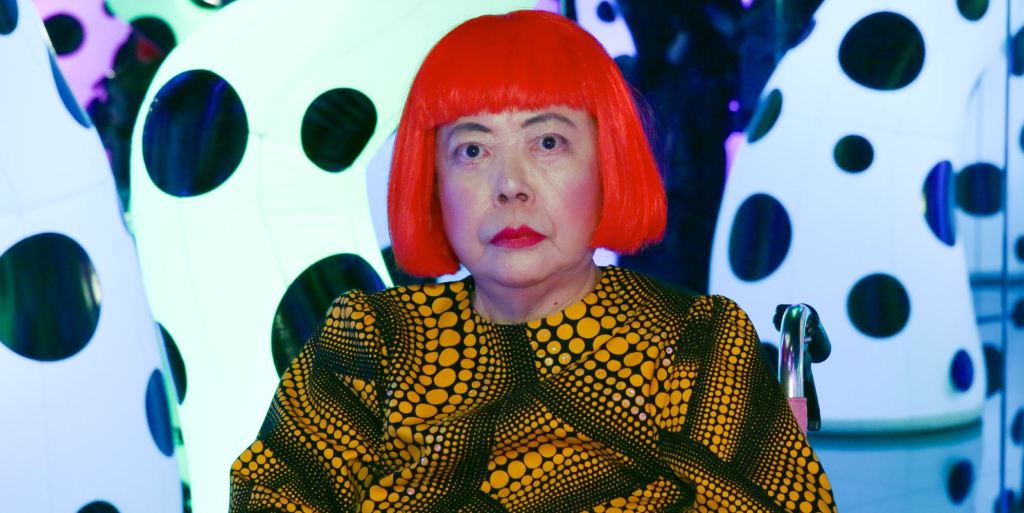
Kusama’s rise to international fame came after decades of being overlooked and dismissed by the male-dominated art world. She moved to New York in the late 1950s after writing to Georgia O’Keeffe, whom she saw as a kindred spirit. Shereceived both encouragement and a warning from her in a letter which read: “In this country an artist has a hard time making a living,” as reported by the BBC.
Kusama caused a stir in the New York art scene with experimental works featuring phallic sculptures, nudity and provocative performances. She later became particularly famous for her immersive Infinity Mirror Rooms, as well as her signature polka dots and brightly coloured pumpkin sculptures.
The artist was deeply frustrated when male contemporaries, including Andy Warhol, Claes Oldenburg and Lucas Samaras, received greater recognition for ideas she believed had been copied or influenced by her work. She eventually returned to Japan, where she entered a psychiatric facility and found an environment that allowed her to continue working.
Her career was transformed decades later, when her work was embraced by major museums, international audiences and luxury brands including Louis Vuitton. She represented Japan at the Venice Biennale in 1993 and became a global cultural icon in her 80s and 90s, with social media helping introduce her work to a new generation.
The artist identified as asexual and developed an aversion to sex after, as a child, her mother forced her to spy on her father with his lovers. Yet sexuality became a recurring theme in her work.
Kusama explained in her 2002 autobiography Infinity Net that: “People often assume that I must be mad about sex, because I make so many such objects, but that’s a complete misunderstanding. It’s quite the opposite – I make the objects because they horrify me. I began making penises in order to heal my feelings of disgust towards sex. Reproducing the objects, again and again, was my way of conquering the fear. It was a kind of self-therapy, to which I gave the name ‘Psychosomatic art’.”
“I make a pile of soft sculpture penises and lie down among them. That turns the frightening thing into something funny, something amusing. I’m able to revel in my illness in the dazzling light of day. By now, the number of penises I have made easily reaches into the hundreds of thousands,” she wrote.
Beyond sex and sexuality, Kusama’s art was deeply shaped by her experiences with hallucinations and her own perception of the world. She described seeing patterns and objects multiply across rooms and over her own body, later turning those experiences into art that allowed other people to see the world as she experienced it.
Kusama spent her life refusing to stop creating. Her polka dots, pumpkins and endless mirrored spaces have become instantly recognisable pieces of contemporary culture.
She leaves behind a body of work that turned deeply personal experiences into something millions of people could see, enter and experience for themselves.
Share your thoughts! Let us know in the comments below, and remember to keep the conversation respectful.
The post Japanese polka dot artist Yayoi Kusama dies aged 97 appeared first on PinkNews | Latest lesbian, gay, bi and trans news | LGBTQ+ news.